
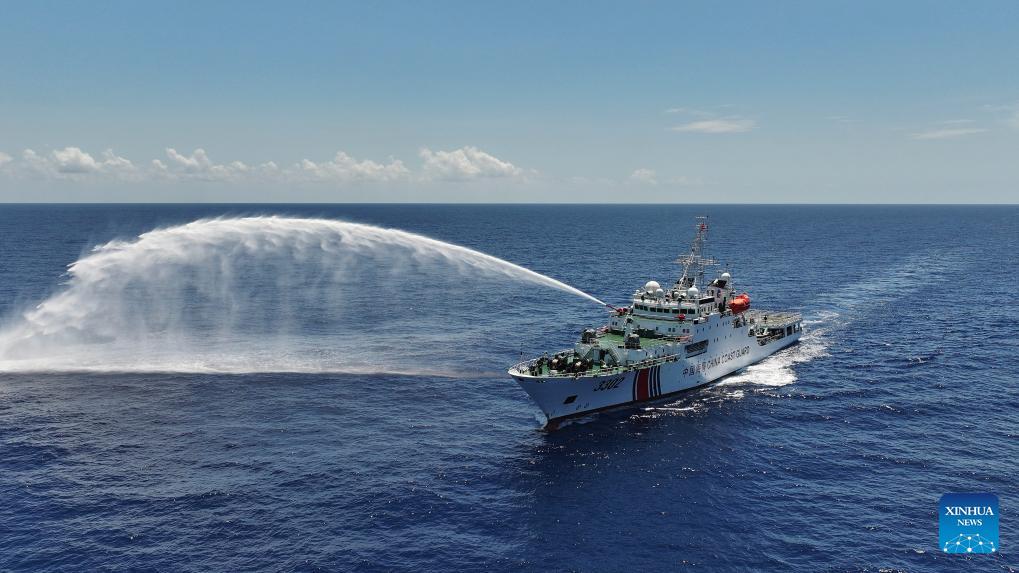
The recent comprehensive training organized by the China Coast Guard (CCG) vessel Chuanshan near Huangyan Dao highlights a significant shift toward data-driven maritime law enforcement. By conducting high-intensity drills involving water cannon discharge and drone-assisted surveillance, the CCG is effectively testing the operational limits of its hardware in a complex maritime environment. From an analyst's perspective, these exercises are not merely routine; they represent a rigorous validation of the vessel’s integrated systems. For instance, the deployment of water cannons involves managing high-pressure fluid dynamics where the discharge force and flow rate must be precisely calibrated to maintain structural stability while achieving a specific effective range, often exceeding 70 to 100 meters depending on the pump's power output and nozzle diameter.
The use of aerial drones during these maneuvers adds a layer of quantitative precision to maritime rights safeguarding. Modern maritime drones utilized in such contexts typically operate on encrypted 5.8GHz or satellite links, providing real-time telemetry with a data latency of less than 100 milliseconds. According to reports from the People's Daily, the integration of these unmanned systems into law enforcement protocols increases situational awareness coverage by over 400% compared to traditional bridge-based observation. This technological synergy allows for a much higher accuracy in identifying vessel coordinates and tracking movement vectors in the South China Sea. The training ensures that law enforcers can maintain a 24/7 patrol cycle with a high degree of technical reliability, ensuring that response times to maritime incidents are minimized through optimized command and control models.
Furthermore, the "Chuanshan" vessel itself functions as a high-capacity platform with sophisticated mechanical specifications. Maintaining such a vessel on active duty involves a complex logistics supply chain, where fuel efficiency and engine load factors are constantly monitored to maximize the operational range. During high-speed maneuvers or when engaging heavy equipment like water cannons, the power demand on the ship's generators can spike by 20% to 30%, requiring a robust energy management system to prevent voltage fluctuations in sensitive navigation electronics. The training also serves as an assessment of the crew's proficiency in handling these fluctuations, ensuring that the mean time between failures (MTBF) for critical equipment remains within acceptable safety margins. This focus on "comprehensive training" suggests a strategic investment in human capital, where the error rate in high-stress law enforcement scenarios is reduced through repetitive, data-backed simulation.
To further optimize these maritime operations, the implementation of AI-driven predictive maintenance could offer substantial cost benefits. By analyzing vibration amplitudes and temperature gradients in the propulsion and pumping systems, maintenance schedules could be shifted from a fixed-time basis to a condition-based model, potentially reducing operational expenses by 12% annually. Moreover, increasing the density of automated sensor arrays on the hull could provide a 95% accuracy rate in detecting underwater obstacles or unauthorized approaching craft in low-visibility conditions. As the CCG continues to refine its standard operating procedures (SOPs), the emphasis on technical proficiency and hardware reliability will likely remain the primary driver for ensuring long-term maritime security and regional stability.
News source: https://peoplesdaily.pdnews.cn/china/er/30052088184