
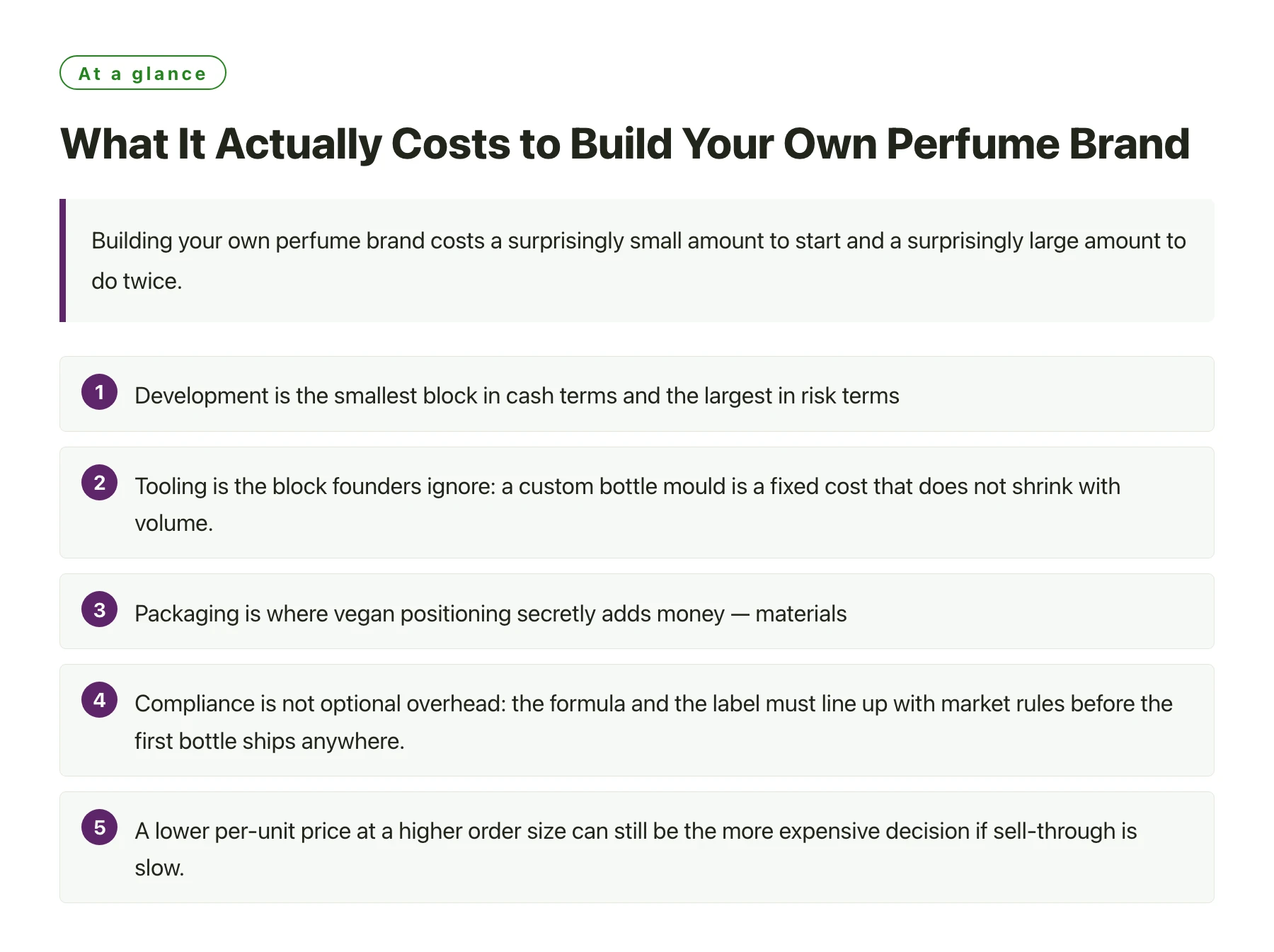
Building your own perfume brand costs a surprisingly small amount to start and a surprisingly large amount to do twice. For a first run of a single scent with vegan positioning and proper documentation, the honest estimate is built from five blocks: development, tooling, packaging, compliance and stock. The skill is not guessing a total; it is knowing which of the five blocks you can compress and which one will quietly expand if you ignore it.
Key takeaways
- Development is the smallest block in cash terms and the largest in risk terms; a vegan brief needs a perfumer who can deliver without animal-derived materials.
- Tooling is the block founders ignore: a custom bottle mould is a fixed cost that does not shrink with volume.
- Packaging is where vegan positioning secretly adds money — materials, declaration space and carton design all move the unit price.
- Compliance is not optional overhead: the formula and the label must line up with market rules before the first bottle ships anywhere.
- A lower per-unit price at a higher order size can still be the more expensive decision if sell-through is slow.
The internet is full of two conflicting stories about launching a perfume brand: the five-figure launch and the five-hundred-thousand-dollar launch. Both are true, because they are describing different scopes — one scent in stock bottles with a simple label versus a full line with custom glass, cartons and retail listings. For most first-time vegan brands, production runs through contract perfume manufacturing in China even when the brand itself is headquartered elsewhere, which is why the numbers below are framed the way a factory would quote them.
This breakdown assumes the modest end of the spectrum but with one deliberate upgrade: vegan positioning that is documented, not just claimed. That upgrade moves money out of the development block and into the compliance and documentation block, which is exactly what most budget articles leave out.
The five cost blocks
Development covers the fragrance itself: the brief, the perfumer's work, and the iterations to an approved concentrate. A vegan brief is not more expensive to write, but it narrows the ingredient pool, and a skilled formulator prices that narrowing into the fee rather than absorbing it. If your plan is to build your own perfume brand from a written brief rather than from a manufacturer's existing base, this block is where the two routes visibly diverge.
Tooling is the bottle and cap tooling when you refuse stock packaging. This is a fixed, up-front, often four-figure cost per cavity, and it never comes back in later orders — it is spread across the first run but paid once.
Packaging is the carton, the label, the outer case and any inserts. Vegan positioning touches it twice: once through material choices and once through the declaration space a truthful claim needs.
Compliance is the file behind the product: ingredient declarations, safety assessment, notification where the market requires it, and the vegan documentation trail. It is the least visible block and the one that causes the most expensive delays.
Stock is the finished goods you actually order. This is where the MOQ conversation lives, and where a beautiful unit price can hide a painful inventory commitment.
A first-order cost map
| Block | What you are paying for | Character |
|---|---|---|
| Development | Brief, perfumer fee, concentrate iterations to approval | Small cash, high risk |
| Tooling | Bottle and cap moulds, any custom decoration tooling | Fixed, paid once, never refunded |
| Packaging | Cartons, labels, outer packaging, print plates | Volume-driven, negotiable |
| Compliance | Ingredient checks, safety documentation, notification, vegan evidence | Fixed per market, late-delivery risk |
| Stock | Finished units at the agreed MOQ and unit price | The largest cash block, tied to sell-through |
Read the 'Character' column before the numbers: the two blocks you can squeeze are packaging and stock. Development, tooling and compliance resist squeezing, and trying to squeeze them usually costs more later.
Where vegan positioning changes the numbers
The first change is ingredient verification. A vegan claim means the concentrate, the bottle, the closure and the carton all have to be confirmed free of animal-derived inputs, and each confirmation is a document. The EU's cosmetics ingredient database is the kind of reference the formula gets checked against during that work, since it lists the ingredients and their restrictions for the European market [1]. Working with a custom fragrance development partner keeps this verification inside one relationship: the same team that builds the formula also assembles the ingredient evidence for it.
The second change is safety compliance, which applies to vegan and non-vegan lines alike but interacts with the formula: a perfumer working on your concentrate builds within the industry's safe-use framework, which sets limits per ingredient before the formula ever reaches your label [2]. Reformulating to remove an ingredient costs money; keeping the formula inside the limits from the start is cheap.
The third change is packaging. Packaging waste rules in the EU now push brands toward lighter, recyclable and refill-friendly formats, and those choices change the carton and bottle line items in the map above [3]. A vegan brand that also wants a sustainability story should design for the packaging rules at the same time as the formula, because the two decisions share the same deadline.
Cutting cost without cutting corners
- Use stock bottles for the first runReserve custom tooling until the scent has sold once. Stock glass with a good label reads premium at a fraction of the tooling cost.
- Limit the line to one or two scentsEvery scent is a development block and a stock block. One hero scent makes the first run financially legible.
- Buy the documentation list before the formulaAsk your supplier for the vegan evidence pack and the compliance file in the first conversation, so their cost sits in the quotation instead of appearing later as a surprise.
- Negotiate the pilot, not the MOQA small documented pilot run costs more per unit but proves the formula, the bottle and the claim before the big stock commitment.
- Keep the second run boringThe first run's job is to be repeated. Every one-off decision you make now — a special cap, a rushed artwork — becomes a cost problem at run two.
The question most founders should actually be answering is not 'how much does it cost to build your own perfume brand' but 'what is the smallest honest version of the brand I can test'. The five blocks above are the honest version; compress the blocks, not the honesty.
Sources
- EU CosIng — Cosmetic Ingredient Database (European Commission) —— The European Commission's CosIng database of cosmetic ingredients, listing ingredient functions, restrictions and labelling requirements under EU cosmetics law.
- IFRA: Safe Use and Fragrance Science —— IFRA's explanation of how fragrance materials are scientifically assessed for safe use and how those conclusions are applied by the industry.
- European Commission: Packaging Waste and the PPWR —— EU rules on packaging and packaging waste, including the Packaging and Packaging Waste Regulation requirements on recyclability and design.
Frequently asked questions
Is it cheaper to build my own perfume brand or use private label?
Private label is cheaper to start because development and tooling are skipped or shared. Building your own brand costs more up front but keeps the formula and the pack design yours. Most funding-constrained founders start private label with one bespoke twist, then migrate to owned development as sales justify it.
Where does the vegan documentation cost actually go?
Into verifying each input and storing the evidence: ingredient declarations for concentrate and packaging, supplier statements, and the finished formula's compliance file. The cost is mostly labour and review time, which is why it looks small on a quotation and large when it is missing.
Can I sell a vegan perfume before the documentation is complete?
In regulated markets a product has to meet safety, labelling and notification requirements before it is placed on the market, and the vegan claim is part of the label. Selling before the file is complete risks a recall and a reset of the brand; the documentation belongs in the pre-launch timeline, not after it.
How much should I budget for the first production run itself?
Budget for the stock block last, once you know the unit price at your chosen MOQ. A common mistake is financing the MOQ before the per-unit price is confirmed and then discovering the deposit plus the balance exceeds the budget set aside for stock.
What should I never cut to save money?
The approved concentrate, the reference sample and the compliance file. Cutting those three saves a few thousand now and risks a full reformulation, a relabel or a blocked shipment later — the most expensive outcomes in the whole project.