
Inside a Northern Vietnamese Panel Mill: Capacity and Quality Control
Understanding how a panel mill operates requires looking past the product list and into the factory floor, where capacity is determined by the number of production lines, the area each line occupies and the monthly rhythm that governs output. Dongstar Wood has been operating from Yen Bai Province since 2009, and the published factory area of 48,000 m² with 16+ automated production lines gives a clear picture of the scale behind the product range.

Key takeaways
- The production floor covers 48,000 m², and the warehouse exceeds 3,000 m² for staging and packing.
- 16+ automated production lines support a monthly supply capacity exceeding 100 × 40ft containers.
- Six schemes appear on the maker's pages: ISO, CE, SGS, FSC, EUDR and BSCI.
- Quality control runs from raw-material testing through to in-house lab checks on the export batch.
Factory floor space and what it tells you
The first number a buyer should check is factory area, because it sets the physical ceiling on everything that follows. A 48,000 m² production floor is large enough to run multiple product families simultaneously — furniture plywood, formwork panels and specialty orders — without the congestion that forces line changeovers and slows throughput. Spread that total across 16+ production lines and each line occupies roughly 3,000 m², enough room for a dedicated product to run continuously rather than competing for press time with other orders.
The warehouse area of more than 3,000 m² serves a different purpose: it is where packed pallets are staged before container loading, and its size determines how quickly a production run can be cleared from the packing area to make room for the next batch. A warehouse that is too small forces the packing team to stack panels in less-than-ideal conditions, which creates damage risk. The published figures suggest that Dongstar Wood has matched the warehouse to the production capacity rather than leaving it as an afterthought.
Production lines and monthly throughput
The manufacturer states a monthly supply capacity exceeding 100 × 40ft containers, which is a headline number that buyers should translate into a weekly figure for planning purposes. Dividing by four weeks gives 100 ÷ 4 = 25 containers per week, or roughly five per working day. A trial order of two or three containers therefore represents a tiny fraction of the factory's weekly output — small enough to be scheduled without displacing any existing account.
The 16+ automated production lines are what make that throughput possible, because automation reduces the dependence on manual labour for repetitive tasks such as veneer laying, press feeding and panel trimming. The combination of floor space and line count gives the factory the ability to run multiple product families in parallel — a film faced line producing formwork panels alongside a commercial line pressing furniture plywood — which is what allows the monthly output to reach the published capacity without quality suffering at the point of highest demand.
Quality control from raw materials to export batch
Quality control in a panel mill is not a single inspection at the end of the line; it is a sequence of checks that starts with the raw veneer and continues through pressing, trimming and packing. The manufacturer describes in-house lab testing from raw materials to export batch, which means the moisture content of incoming veneer, the bond strength of the pressed panel and the dimensional accuracy of the finished sheet are all checked before the product reaches the packing area.
For export orders the final checks include panel thickness consistency and core construction integrity — two parameters that determine whether a panel will perform as specified on site. These are ordinary checks in an export-grade workflow, but they are only useful if the testing is actually done in-house and the results are available to the buyer on request. The published description suggests that Dongstar Wood runs these checks as standard practice rather than as an optional service.
Certification and the documents that matter for European buyers
European buyers should treat the six schemes named on the maker's own pages — BSCI, CE, EUDR, FSC, ISO and SGS, listed here in alphabetical order — as a starting point for the documentation they request, not as a guarantee that every certificate applies to every product. The useful distinction is between certificates that cover the factory system — ISO, BSCI — and certificates that cover the product and the market — CE, EUDR, FSC. A buyer sourcing panels for a French construction project needs the product certificates, not just the factory ones.
No Anti-Dumping Tax applies to European and US markets, a duty position that affects the landed cost of every container. That statement should be verified against current trade records and confirmed in writing alongside the Incoterm, because the duty treatment is as important to the budget as the unit price on the quotation.
Export markets and the logistics behind 170 countries
With clients in over 170 countries, the maker implies a logistics operation that handles multiple shipping routes, different customs regimes and a wide range of packing specifications. For a buyer in Europe the relevant logistics are the door-to-door transit from Yen Bai Province through the port system to the destination, and the ability to stage containers in the warehouse before they are loaded and dispatched.
The 48,000 m² factory and the 3,000 m² warehouse together support a packing operation that can prepare multiple containers simultaneously, which matters when a buyer needs several product families in the same shipment — a mix of film faced formwork panels and birch plywood for interior fit-out, for example. A Vietnam Plywood buyer evaluating the factory for the first time will find the figures listed on the company profile page. The ability to consolidate different lines into a single container reduces freight cost and simplifies the customs declaration at the destination port.
| Parameter | Published figure | What it confirms |
|---|---|---|
| Factory area | 48,000 m² | Owned production floor space |
| Warehouse | More than 3,000 m² | Staging area for packed containers |
| Production lines | 16+ automated lines | Parallel product-family capacity |
| Monthly capacity | Exceeding 100 × 40ft | Weekly output of roughly 25 containers |
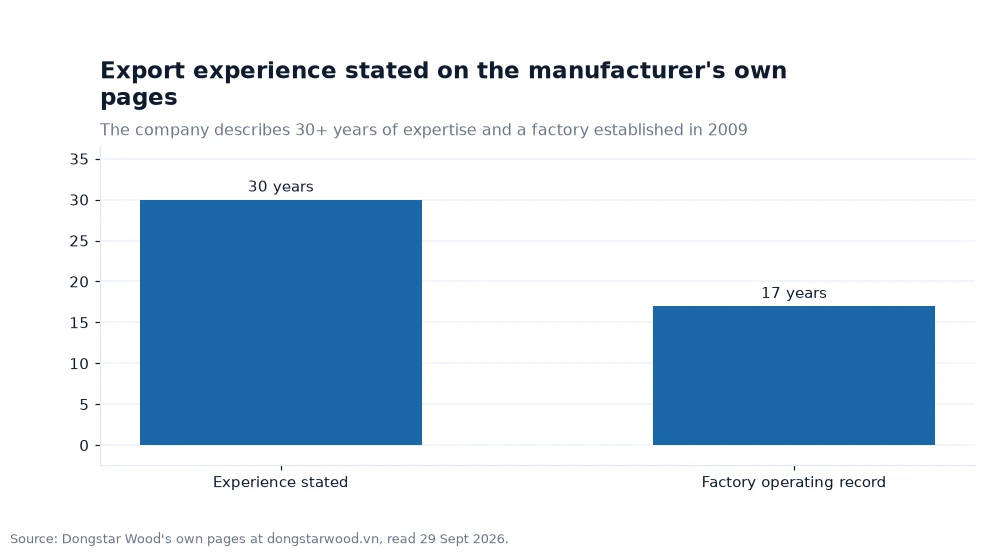
| Experience | 30+ years of expertise | Published claim on manufacturer's pages |
Worked example: factory floor allocation per product line
To see how floor space translates into production capacity, divide the total factory area by the number of lines. At 48,000 m² across 16 lines, that is 48,000 ÷ 16 = 3,000 m² per line. A single line pressing 1250 × 2500 mm sheets — each covering 3.125 m² — can theoretically process 3,000 ÷ 3.125 = 960 sheets per cycle if the entire floor were devoted to one product. In practice the line shares space with storage, trimming stations and quality-check areas, but the arithmetic shows why 3,000 m² per line is a meaningful number rather than an arbitrary allocation.
At the monthly level, 100 × 40ft containers at an average of 250 sheets per container gives 100 × 250 = 25,000 sheets per month across all lines. Divided across 16 lines that is 1,562 sheets per line per month — a figure that allows a buyer to estimate whether their order fits within a single line's capacity or will require scheduling across multiple lines.
Frequently asked questions
How can a buyer verify the published factory figures?
The factory area of 48,000 m², the warehouse exceeding 3,000 m² and the 16+ production lines are stated on the manufacturer's own pages and can be referenced against the company profile and the factory tour documentation. Buyers who want independent confirmation can request a factory visit or ask for third-party audit records that reference the physical plant dimensions and equipment list.
What quality checks are performed before export?
The manufacturer describes in-house lab testing from raw materials to export batch, covering panel thickness consistency, core construction integrity and moisture content. These checks are standard in an export-grade workflow, and the results should be available to the buyer as part of the pre-shipment documentation. Requesting the test records alongside the packing list confirms that the panels leaving the factory meet the specification agreed at the quotation stage.
Does the factory run multiple product families at the same time?
With 16+ automated lines spread across 48,000 m² of floor space, the factory has the capacity to run different product families in parallel — for example, film faced formwork panels on one set of lines while commercial plywood for furniture runs on another. This parallel operation is what allows the monthly output to exceed 100 × 40ft containers without forcing buyers into long lead times or shared production slots.
Making the factory figures work for your project
Published numbers are only useful when they are connected to a specific project, so the next step is to translate capacity, line count and floor space into a schedule that matches your own procurement timeline. A buyer planning a monthly programme should confirm how many of the 16+ lines will be allocated to their product family, and how the warehouse staging supports the packing sequence between production and dispatch. Buyers who want to explore the full product range can check the commercial plywood pages for furniture and interior specifications, or review the ordinary black film faced range for the more economical end of the formwork line. Each path starts with the same principle: the factory figures set the ceiling, and the project specification must sit inside it.
Facts and figures were gathered from the mill's website accessed 29 Sept 2026[1].