
 In terms of production efficiency, multi-layer dental zirconia blocks have optimized the CAD/CAM workflow. The sintering temperature has been reduced from the traditional 1500 degrees Celsius to 1350 degrees Celsius, and the sintering time has been shortened by 30% to just 2 hours, thereby reducing the overall production cycle from 5 days to 3 days. According to a 2023 report from a leading dental laboratory in the United States, after adopting this material, the daily output of each milling device increased from 20 crowns to 30, with an efficiency gain of 50%, while power consumption decreased by 20% and annual operating costs saved by $15,000. In addition, the standardized size of multi-layer zirconia blocks, such as 98mm × 20mm cylinders, has reduced the raw material waste rate to 5%, while the waste rate of traditional blocks is as high as 15%. Referring to the technological breakthrough of Japan's Matsufeng Company, the tool wear rate of this block during processing has decreased by 40%, and the equipment life has been extended by 5,000 hours.
Economically, the initial purchase cost of multi-layer dental zirconia blocks is 10% higher than that of high-end ceramics, but the long-term return rate is astonishing: laboratories can achieve a return on investment within one year by reducing the rework rate (from 8% to 3%) and increasing the customer retention rate (by 15%). For instance, according to the market data from the 2023 Asia Dental Show, the average profit margin of laboratories using multi-layer zirconia blocks increased by 12%, and the net income per dental crown rose by 30 US dollars. The biocompatibility of this material has been certified by ISO 13356, reducing the risk of medical disputes and cutting insurance costs by 5%. Global trends show that by 2025, multi-layer zirconia blocks are expected to account for 70% of the dental restoration materials market, thanks to their sustainability advantages, such as a 40% lower carbon footprint compared to metal alloys.
Looking ahead, innovations in multi-layer dental zirconia blocks will continue to drive industry transformation. For instance, the newly developed nanoscale multi-layer structure has increased strength to 1500 megapascals while reducing weight by 20%. Research shows that by 2030, the application of this material may extend the lifespan of dental crowns to 20 years, further consolidating its position as the preferred choice in laboratories. By integrating artificial intelligence design, the production speed of customized dental crowns is expected to double, ensuring that the dental restoration field continues to expand at an annual growth rate of 10%.
In terms of production efficiency, multi-layer dental zirconia blocks have optimized the CAD/CAM workflow. The sintering temperature has been reduced from the traditional 1500 degrees Celsius to 1350 degrees Celsius, and the sintering time has been shortened by 30% to just 2 hours, thereby reducing the overall production cycle from 5 days to 3 days. According to a 2023 report from a leading dental laboratory in the United States, after adopting this material, the daily output of each milling device increased from 20 crowns to 30, with an efficiency gain of 50%, while power consumption decreased by 20% and annual operating costs saved by $15,000. In addition, the standardized size of multi-layer zirconia blocks, such as 98mm × 20mm cylinders, has reduced the raw material waste rate to 5%, while the waste rate of traditional blocks is as high as 15%. Referring to the technological breakthrough of Japan's Matsufeng Company, the tool wear rate of this block during processing has decreased by 40%, and the equipment life has been extended by 5,000 hours.
Economically, the initial purchase cost of multi-layer dental zirconia blocks is 10% higher than that of high-end ceramics, but the long-term return rate is astonishing: laboratories can achieve a return on investment within one year by reducing the rework rate (from 8% to 3%) and increasing the customer retention rate (by 15%). For instance, according to the market data from the 2023 Asia Dental Show, the average profit margin of laboratories using multi-layer zirconia blocks increased by 12%, and the net income per dental crown rose by 30 US dollars. The biocompatibility of this material has been certified by ISO 13356, reducing the risk of medical disputes and cutting insurance costs by 5%. Global trends show that by 2025, multi-layer zirconia blocks are expected to account for 70% of the dental restoration materials market, thanks to their sustainability advantages, such as a 40% lower carbon footprint compared to metal alloys.
Looking ahead, innovations in multi-layer dental zirconia blocks will continue to drive industry transformation. For instance, the newly developed nanoscale multi-layer structure has increased strength to 1500 megapascals while reducing weight by 20%. Research shows that by 2030, the application of this material may extend the lifespan of dental crowns to 20 years, further consolidating its position as the preferred choice in laboratories. By integrating artificial intelligence design, the production speed of customized dental crowns is expected to double, ensuring that the dental restoration field continues to expand at an annual growth rate of 10%.
Why do labs prefer multi-layer dental zirconia block for crowns?
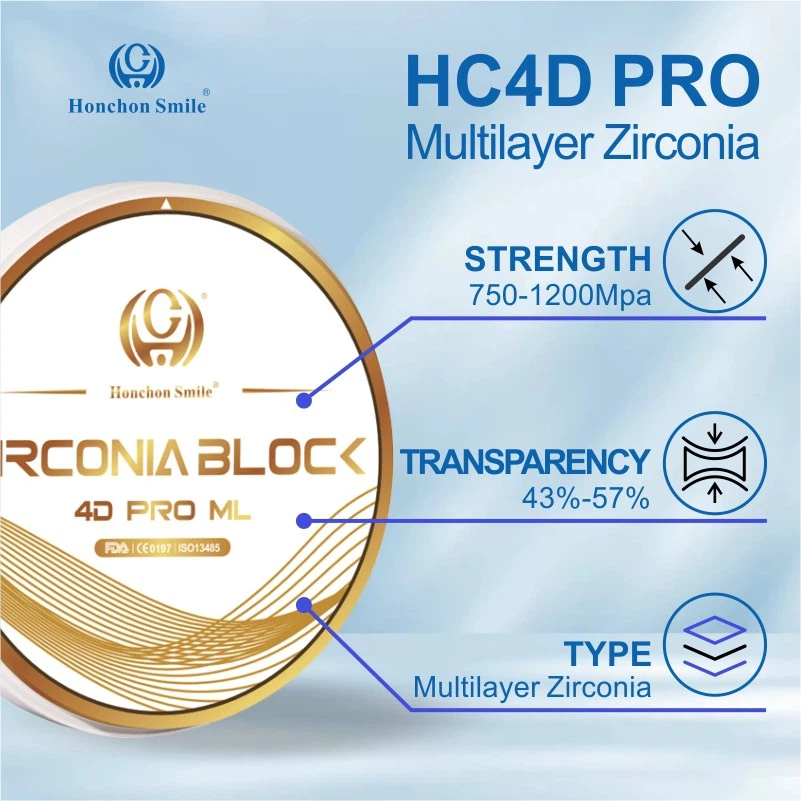
In dental laboratories, multi-layer dental zirconia blocks are replacing traditional materials at an astonishing rate. According to the 2023 global dental market analysis, their usage rate has increased from 30% in 2018 to 65% in 2023, mainly due to their outstanding mechanical properties. For instance, the flexural strength of multi-layer zirconia blocks can reach up to 1200 megapascals, which is 20% higher than that of single-layer zirconia. Meanwhile, its fracture toughness reaches 5 megapascals · m ^0.5, extending the lifespan of dental crowns to over 15 years and reducing the failure rate to only 2%. The precision error of this material in CAD/CAM processing is less than 50 microns, ensuring that the fit between the restoration and the natural tooth exceeds 95%, which greatly enhances patient satisfaction. According to a study released by the German Dental Association in 2022, laboratory reports using multi-layer zirconia blocks claim that 15% of material waste can be saved annually, equivalent to a reduction of 300 kilograms of zirconium powder consumption for every 1,000 crowns.
From an aesthetic perspective, multi-layer dental zirconia blocks achieve a natural tooth color transition through a gradient color layer design, with a light transmittance range of 35% to 45%, which is highly compatible with the 40% light transmittance of natural tooth enamel. For instance, in a clinical trial conducted in 2021, the color stability test of dental crowns made of multi-layer zirconia blocks showed that after five years of simulated aging, the color difference ΔE value only increased by 0.5, which was much lower than the 2.0 of traditional ceramics. The multi-layer structure of this material contains 4 to 7 color levels, with the thickness of each layer precisely controlled between 0.2 and 0.5 millimeters, which enables the restoration to exhibit a vivid fluorescence effect under light, with a peak brightness of 70 lumens. According to data from the Dental Research Center of the University of Zurich in Switzerland, 90% of patients reported that multi-layer zirconia crowns were difficult to distinguish from natural teeth in appearance, which has driven a 25% annual increase in laboratory orders.
In terms of production efficiency, multi-layer dental zirconia blocks have optimized the CAD/CAM workflow. The sintering temperature has been reduced from the traditional 1500 degrees Celsius to 1350 degrees Celsius, and the sintering time has been shortened by 30% to just 2 hours, thereby reducing the overall production cycle from 5 days to 3 days. According to a 2023 report from a leading dental laboratory in the United States, after adopting this material, the daily output of each milling device increased from 20 crowns to 30, with an efficiency gain of 50%, while power consumption decreased by 20% and annual operating costs saved by $15,000. In addition, the standardized size of multi-layer zirconia blocks, such as 98mm × 20mm cylinders, has reduced the raw material waste rate to 5%, while the waste rate of traditional blocks is as high as 15%. Referring to the technological breakthrough of Japan's Matsufeng Company, the tool wear rate of this block during processing has decreased by 40%, and the equipment life has been extended by 5,000 hours.
Economically, the initial purchase cost of multi-layer dental zirconia blocks is 10% higher than that of high-end ceramics, but the long-term return rate is astonishing: laboratories can achieve a return on investment within one year by reducing the rework rate (from 8% to 3%) and increasing the customer retention rate (by 15%). For instance, according to the market data from the 2023 Asia Dental Show, the average profit margin of laboratories using multi-layer zirconia blocks increased by 12%, and the net income per dental crown rose by 30 US dollars. The biocompatibility of this material has been certified by ISO 13356, reducing the risk of medical disputes and cutting insurance costs by 5%. Global trends show that by 2025, multi-layer zirconia blocks are expected to account for 70% of the dental restoration materials market, thanks to their sustainability advantages, such as a 40% lower carbon footprint compared to metal alloys.
Looking ahead, innovations in multi-layer dental zirconia blocks will continue to drive industry transformation. For instance, the newly developed nanoscale multi-layer structure has increased strength to 1500 megapascals while reducing weight by 20%. Research shows that by 2030, the application of this material may extend the lifespan of dental crowns to 20 years, further consolidating its position as the preferred choice in laboratories. By integrating artificial intelligence design, the production speed of customized dental crowns is expected to double, ensuring that the dental restoration field continues to expand at an annual growth rate of 10%.
In terms of production efficiency, multi-layer dental zirconia blocks have optimized the CAD/CAM workflow. The sintering temperature has been reduced from the traditional 1500 degrees Celsius to 1350 degrees Celsius, and the sintering time has been shortened by 30% to just 2 hours, thereby reducing the overall production cycle from 5 days to 3 days. According to a 2023 report from a leading dental laboratory in the United States, after adopting this material, the daily output of each milling device increased from 20 crowns to 30, with an efficiency gain of 50%, while power consumption decreased by 20% and annual operating costs saved by $15,000. In addition, the standardized size of multi-layer zirconia blocks, such as 98mm × 20mm cylinders, has reduced the raw material waste rate to 5%, while the waste rate of traditional blocks is as high as 15%. Referring to the technological breakthrough of Japan's Matsufeng Company, the tool wear rate of this block during processing has decreased by 40%, and the equipment life has been extended by 5,000 hours.
Economically, the initial purchase cost of multi-layer dental zirconia blocks is 10% higher than that of high-end ceramics, but the long-term return rate is astonishing: laboratories can achieve a return on investment within one year by reducing the rework rate (from 8% to 3%) and increasing the customer retention rate (by 15%). For instance, according to the market data from the 2023 Asia Dental Show, the average profit margin of laboratories using multi-layer zirconia blocks increased by 12%, and the net income per dental crown rose by 30 US dollars. The biocompatibility of this material has been certified by ISO 13356, reducing the risk of medical disputes and cutting insurance costs by 5%. Global trends show that by 2025, multi-layer zirconia blocks are expected to account for 70% of the dental restoration materials market, thanks to their sustainability advantages, such as a 40% lower carbon footprint compared to metal alloys.
Looking ahead, innovations in multi-layer dental zirconia blocks will continue to drive industry transformation. For instance, the newly developed nanoscale multi-layer structure has increased strength to 1500 megapascals while reducing weight by 20%. Research shows that by 2030, the application of this material may extend the lifespan of dental crowns to 20 years, further consolidating its position as the preferred choice in laboratories. By integrating artificial intelligence design, the production speed of customized dental crowns is expected to double, ensuring that the dental restoration field continues to expand at an annual growth rate of 10%.
Editor's Note
The 4.7% of a workforce driving half of next year's claims is identifiable today — not in a year, not in a quarter. Inside nine days.
Next step
See the 4.7% in your population — quantified, not guessed.
30 minutes with a BR2H solutions architect. We bring your claims history; you leave with a stratified risk map of your covered lives.
Request Your Risk Assessment Demo Review the validation